
Welcome to UK History News. In each monthly issue, free subscribers will receive the latest British history-related headlines, along with notable upcoming anniversaries. And below the paywall, paid subscribers will see many more news items, all of them briefly summarised here in one place.
Top headlines
A nation shaped by rain: exhibition celebrates Scotland’s wettest obsession [The Guardian]: The National Library of Scotland in Edinburgh has opened ‘Rain’ (19 June–30 April 2027), an exhibition exploring how rainfall shaped Scottish science, literature, history and identity – from James Hutton’s 18th‑century ‘theory of rain’ and Charles Macintosh’s rainproof fabric to exhibits featuring Minnie the Minx, Robert Burns and Macbeth, historic rain maps, interactive forecast displays – dedicated to conservator Mel Houston, who died in a 2023 flash flood.
Brunel’s SS Great Britain site unveils new name [BBC News]: Bristol’s SS Great Britain site is being renamed Bristol Dockyards and on 18 July will reopen with a 2,000 sq ft interactive exhibition – the result of five years’ community research – that shifts focus from Isambard Kingdom Brunel to the ship’s untold human stories, from passengers of 51 nations and local labourers to people of colour like Jamaican cook George Moses and Barbadian poet James W Jones, its role in carrying nearly 15,900 emigrants to Australia (including the first First Nations cricket team), and its use in 19th-century imperial conflicts.
Crucial George Washington letter to go on display [BBC News]: To mark the 250th anniversary of the US Declaration of Independence, The National Archives in Kew will, for the first time in London, display an October 1781 letter signed by George Washington accepting the British surrender after Yorktown – which helped set in motion the negotiations leading to the 1783 Treaty of Paris – alongside other Revolutionary-era documents in the Revolution 250 exhibition running through 29 November.
Heritage sites to visit this summer [The National Lottery Heritage Fund]: The National Lottery Heritage Fund, which has supported over 53,000 projects since 1994, has invested millions to restore and reopen UK heritage sites – such as Hull’s restored Spurn Lightship, the Quentin Blake Centre for Illustration in Clerkenwell, a rescued Grade I church in Newark, Castlewellan’s Annesley Walled Garden, the renovated Sunday School Hall at Islington’s Union Chapel, and Orkney’s Tomb of the Eagles – now open for public visits.
Hidden tunnels dating back to Henry VIII’s reign discovered at English boarding school [smithsonianmag.com]: While repairing a ha-ha at New Hall School in Chelmsford – once Henry VIII’s Beaulieu palace – workers uncovered arched entrances to brick tunnels and a cache of Tudor-era pottery, bones, glass and lead fragments, prompting historians and archaeologists to begin excavations to investigate the rare schoolyard finds and their ties to the estate’s royal past.
How did Stonehenge get its altar stone? New research adds to the debate between human effort and glacier transport [smithsonianmag.com]: Researchers who traced Stonehenge’s 13,000-pound altar stone to northeast Scotland – about 450 miles from the monument – say ice transport during the last Ice Age is theoretically possible but unlikely based on glacier reconstructions, and conclude it was most plausibly hauled in stages by Neolithic people over land and water, implying sophisticated planning and cooperation.
London Museum Smithfield site to open in November [BBC News]: The Museum of London will reopen in its new Smithfield Market home on 28 November – the culmination of a £437m move from its London Wall site closed in December 2022 – with permanent displays from its seven‑million‑object collection (including Banksy’s piranhas, part of the Whitechapel fatberg, the UK’s oldest handwritten document, the Cheapside Hoard, Paul Simonon’s smashed bass and King Charles I’s silk vest), daytime and nightlife programming beneath the Victorian market dome, and basement galleries traversed by Thameslink trains, while the adjacent Poultry Market is scheduled to open later.
London Transport Museum to get makeover [BBC News]: Transport for London will refurbish the Grade II–listed London Transport Museum ahead of its 50th anniversary – keeping it open during works – by adding a ‘spectacular’ public entrance from Covent Garden Piazza, around 500m² of new gallery space and low‑carbon heating and other environmental upgrades aimed at modernizing the Victorian building and boosting annual visits by about 20%.
Major Oak, the 1,200-year-old tree with ties to Robin Hood, is presumed dead [smithsonianmag.com]: Conservationists said that the Major Oak – a roughly 1,200‑year‑old Sherwood Forest oak tied to the Robin Hood legend – has died, declared by the RSPB after it failed to leaf this spring, with experts blaming invasive historic repairs, soil compaction from millions of visitors and climate‑driven heat and drought, and saying the tree will be left standing to provide habitat while its genetics live on in propagated saplings.
Simpler, older version of Stonehenge found three miles from famous site [BBC News]: Archaeologists found two 5,000‑year‑old postholes at Bulford aligned to summer solstice sunrise and winter solstice sunset – predating Stonehenge by about 500 years and accompanied by pottery, flint tools and animal bones that suggest seasonal gatherings and a link to the builders of early Stonehenge phases.
Stonehenge exhibition opens virtually for solstice [BBC News]: To coincide with the summer solstice, the British Museum and University of Reading (with help from the University of Southampton) launched an online, laser-scanned virtual version of their 2022 ‘World of Stonehenge’ exhibition – featuring rare objects like the Nebra Sky Disc and Seahenge – and allowing visitors to go ‘inside the henge’ to see it being built.
Tiny artefact found in Kent shakes up Sutton Hoo helmet’s origin story [Times]: The die stamp found in a field in the South East has opened up the possibility that the Anglo-Saxon treasure was manufactured nearby.
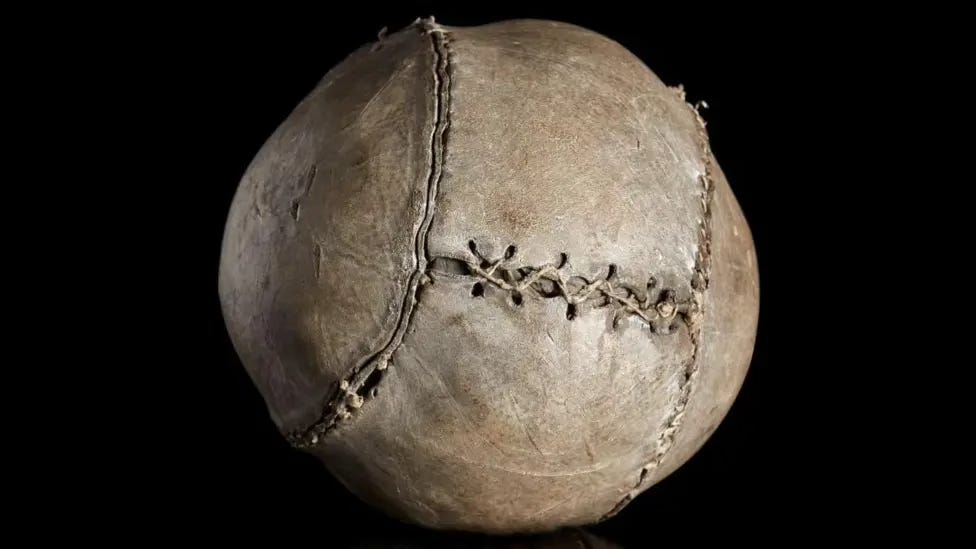
World’s oldest football heads to World Cup for the first time in its history [BBC]: A nearly 500‑year‑old leather football, dated to 1540–1570 and discovered wedged behind the Queen’s Chamber at Stirling Castle, has been sent from the Stirling Smith Museum to Miami to be displayed during the World Cup, with curators suggesting Mary, Queen of Scots might once have played with it.
The best of UK history publishing
Heritage Hunter publishes a wide variety of books relating to British family/social/local history, heritage and historical travel.
Also available: professional history publishing services for your book.
Notable anniversaries coming up
2 July
250 years ago...1776: American Revolution: The Continental Congress adopts the Lee Resolution severing ties with the Kingdom of Great Britain, although the wording of the formal Declaration of Independence is not adopted until July 4.
5 July
200 years ago...1826: Death of Stamford Raffles, English politician, founded Singapore (born 1782)
6 July
90 years ago...1936: A major breach of the Manchester, Bolton and Bury Canal in England sends millions of gallons of water cascading 200 feet (61 m) into the River Irwell.
7 July
250 years ago...1776: Death of Jeremiah Markland, English scholar and academic (born 1693)
8 July
175 years ago...1851: Birth of Arthur Evans, English archaeologist and academic (died 1941)
12 July
100 years ago...1926: Death of Gertrude Bell, English archaeologist and spy (born 1868)
14 July
500 years ago...1526: Death of John de Vere, 14th Earl of Oxford, English peer, landowner, and Lord Great Chamberlain of England (born 1499)
18 July
100 years ago...1926: Birth of Elizabeth Jennings, English poet (died 2001)
21 July
50 years ago...1976: Christopher Ewart-Biggs, the British ambassador to the Republic of Ireland, is assassinated by the Provisional IRA.
29 July
225 years ago...1801: Birth of George Bradshaw, English cartographer and publisher (died 1853)
30 July
60 years ago...1966: England defeats West Germany to win the FIFA World Cup at Wembley Stadium 4–2 after extra time.
Articles to read
‘I could be the last surviving Wren linguist and this was the strangest part of my role’ [Daily Express]: Patricia Owtram, who turned 103 on June 18, is believed to be the last surviving member of the elite group of about 400 German‑speaking Wrens recruited into the secret Naval Y Service in WWII – intercepting German naval (Enigma) traffic at stations like Abbots Cliff, later working with SHAEF, receiving France’s Legion d’Honneur for D‑Day support, keeping her role secret for decades, and going on to a distinguished broadcasting career while helping publish her father’s POW diaries.
The museum built from hundreds of rescued sewing machines [BBC News]: After 30 years of rescuing abandoned machines, Dominic Macey and his son Gabriel have turned hundreds of historic sewing machines – dating from the 1870s and including rare wartime and suffragette-linked examples – into the Gates Museum in Street, Somerset, showcasing the evolution of sewing technology, local industrial heritage and sustainability.
The remarkable undisturbed remains of a Saxon saint [BBC News]: Since 881 CE the Church of St Candida and the Holy Cross in Whitchurch Canonicorum has been a pilgrimage site and is unique among English parish churches for containing an intact medieval shrine holding the remains of the Saxon saint St Wite – relics that survived the Reformation and Civil War – and continues to attract visitors from around the world.
The unknown obelisk sparking village debate [BBC News]: A small 150-year-old flint obelisk in an East Sussex car park that has sparked wild local theories—from shot tower to lock-up—has been identified from 1871 maps by historian Kevin Gordon as originally a dovecote, later rebuilt briefly as a children’s playhouse, now weathered and unlisted, and could prompt renewed preservation debate if the site is redeveloped.
⭐️ Paying subscribers can read 29 further news stories below!
Plus, if you’re into archaeology, folklore and landscape stories, read my other, free newsletter…

