
Welcome to the launch edition of UK History News. In each issue, free subscribers will receive a list of links to the latest British history-related news stories, along with notable upcoming anniversaries. And below the paywall, paid subscribers will see more news items, all of them briefly summarised here in one place. (This launch post is fully visible to all subscribers.)
Top 10 news stories in brief
More remains uncovered at Buckingham ‘execution’ cemetery [BBC]
Elgin Marbles will stay on display despite £1bn refurbishment [The Standard]
What were Scotland’s top archaeological finds in 2025? [BBC]
Bronze Age mass burial site mystery near Sanquhar wind farm [BBC]
Dickens museum depicts Victorian era Christmas decorations [BBC]
Defending Hadrian’s Wall took a strong stomach, study finds [The Times]
Christmas 1604 ledger shows Shakespeare top of the bill [The National Archives]
Union Jack flown at the Battle of Trafalgar is saved from being sold abroad [Daily Mail]
You can read summaries of these and 15 further news stories below!
Notable anniversaries
22 December: 60 years ago… 1965: In the United Kingdom, a 70 miles per hour (110 km/h) speed limit is applied to all rural roads including motorways for the first time.
25 December: 75 years ago… 1950: The Stone of Scone, traditional coronation stone of British monarchs, is taken from Westminster Abbey by Scottish nationalist students. It later turns up in Scotland on 11 April 1951.
26 December: 125 years ago… 1900: Evelyn Bark, leading member of the British Red Cross, first female recipient of the CMG, was born (died 1993)
27 December: 80 years ago... 1945: The International Monetary Fund is created with the signing of an agreement by 29 nations.
Content below is normally only available to paid subscribers… but heck, it’s Christmas!
News in detail
‘Shock’ as Banbury Museum’s council funding faces consultation [BBC]
Banbury Museum & Gallery, which draws about 100,000 visitors a year, says it could be forced to close if Cherwell District Council cuts its grant under a 2026/27 budget consultation as the authority looks to save £1.79m. The council has proposed a new operating model that could save £258,000 in 2027/28 but says no final decision has been made, will review consultation responses and aims to help the museum shift to a sustainable alternative funding model ahead of a full council meeting on 23 February. Museum director Simon Townsend warned the move could end 85 years of the attraction, MP Sean Woodcock has launched a petition to find alternative funding, and local museum managers say rising costs threaten cultural venues; the consultation closes on Friday.
More remains uncovered at Buckingham ‘execution’ cemetery [BBC]
Archaeologists working at West End Farm on Brackley Road in Buckingham have uncovered at least 73 individual bodies in 34 graves, first discovered in 2018 during site preparation for development. The burials – predominantly adult males with some juveniles and no females – include 26 skeletons with hands tied behind their backs and show signs of childhood stress, healed fractures and diseases like tuberculosis; carbon dating of one skeleton places the site in the late 13th century, and the lack of grave goods and unusual layout point to a medieval execution cemetery. Only a few artefacts (two buckles spanning late Roman to post‑medieval periods) were found, and further post‑excavation analysis and research will be carried out to fully document and interpret the site.
Elgin Marbles will stay on display despite £1bn refurbishment [The Standard]
The British Museum will keep the Elgin Marbles on display while carrying out a phased £1 billion revamp of its Western Range galleries led by architect Lina Ghotmeh, allowing major artefacts to remain accessible during the works. Greece has long demanded the Marbles’ return, accusing the museum of holding stolen sculptures, but the museum says they were legally acquired and is legally barred from permanently relinquishing items outside of loan agreements, a route Greek authorities reject, leaving talks deadlocked. Museum director Dr Nicholas Cullinan reaffirmed the Marbles will stay in London but said he supports loan deals in principle and that negotiations with Greece continue, with the possibility of shared displays if an agreement can be reached.
18th Century Hadleigh house could become cafe or museum [BBC]
Solby House, an 18th‑century country house at the John Burrows Recreation Ground in Hadleigh that had been used as temporary housing, has been boarded up since June 2025 after the last tenancy expired. Castle Point Borough Council has applied to the housing secretary to repurpose and renovate the vacant building for community and leisure uses, with options including a café and public toilets for park visitors, a museum or archive/learning centre for schools, and meeting space for community groups. Council leaders, including independent deputy leader Warren Gibson and housing lead Rob Lillis, said the site is better suited to leisure than housing and welcomed the progress toward putting Solby House to use for the benefit of the whole community.
‘My metal detecting find in Rugby connects me to lives long ago’ [BBC]
A metal detectorist, Kathy Bonehill, found a 1,500-year-old decorative copper-alloy scabbard chape (dated AD 400–600) on the edge of a field in Kings Newnham, Rugby, and the British Museum’s Portable Antiquities Scheme has declared it a “find of note”. Weighing about nine grams and now on display at Rugby Art Gallery and Museum, the small chape bears a human face flanked by two birds – interpreted by experts as possibly representing Odin and his ravens – suggesting it may be linked to Viking activity in medieval Warwickshire. Bonehill described the “thrill” of cleaning away the grime to reveal the craftsmanship, and local officials welcomed the donation as important evidence of the area’s early medieval past.
North Herts Museum to host nostalgic 80s exhibition [The Comet]
North Herts Museum in Hitchin is hosting ‘I Grew Up 80s’, a free nostalgic exhibition running until 15 March 2026 that offers a lively look at childhood in 1980s Britain with more than 200 objects and interactive displays. Highlights include Betamax tapes, BMX bikes, Transformers toys, a playable Donkey Kong arcade machine, neon signs, 1980s fashion on mannequins and an hour of archival TV footage; the show is from collector and cultural commentator Matt Fox. The museum on Brand Street is open Tuesday–Saturday 10:30–16:30 and Sunday 11:00–15:00, and also features a café.
What were Scotland’s top archaeological finds in 2025? [BBC]
Scotland’s Dig It! project, coordinated by the Society of Antiquaries of Scotland, has listed its top archaeological finds of 2025 spanning five millennia – including Neolithic feasting evidence from Hebridean crannogs, a Bronze Age burnt mound site in Shetland, a Dumfriesshire hillfort that may have been besieged by Romans, and a newly excavated medieval village at Horndean. Analysis of pottery from crannogs showed little change in decoration over 800 years and residue indicating meat and unusually high levels of fish, suggesting organized communal feasting, while the Gletness burnt mound points to prehistoric water‑heating activities of uncertain purpose. The most unusual discovery was a silver amulet found on the Black Isle containing a prehistoric flint ‘elfshot’ arrowhead – mounted in the 17th–18th century as a charm to protect people and animals from elf attacks – which will go on display at Groam House Museum.
True origin of ‘first black Briton’ revealed [BBC]
New high-quality ancient DNA analysis has overturned earlier claims that the Roman-era skeleton dubbed the ‘Beachy Head Lady’ was the “first black Briton” – scientists found no evidence of recent sub‑Saharan ancestry and instead a strong genetic similarity to rural Britain. Radiocarbon dating places the remains between 129–311 AD; she was likely 18–25 years old, about 1.52 m tall, ate a relatively fish-rich coastal diet, and her cause of death is unknown. Previous skull-based reconstructions had depicted her with dark skin and African features, but the multiproxy study published in the Journal of Archaeological Science suggests she probably had blue eyes, light-to-dark skin tones and light hair, clarifying her origins.
Bronze Age mass burial site mystery near Sanquhar wind farm [BBC]
Archaeologists excavating the access route to the Twentyshilling Wind Farm near Sanquhar in Dumfries and Galloway uncovered a Bronze Age barrow containing five tightly packed urns with cremated remains dated to about 1439–1287 BC (roughly 3,300 years ago). The urns held the ashes of at least eight individuals deposited in a single event and buried almost immediately after cremation, a pattern the lead archaeologist said likely reflects a sudden catastrophic episode – possibly famine – rather than the long-term, reused burial traditions seen at other sites. The find, made during required pre-construction archaeology for the operational wind farm, adds to evidence that the Bronze Age in the region may have experienced periods of particular stress and mass mortality.
Historical book reveals bid to rescue Charles I from Leeds [BBC]
The earliest written account of a 1647 plot to rescue King Charles I from Red Hall in Leeds has been revealed in handwritten marginalia of a unique edition of Ralph Thoresby’s Ducatus Leodiensis, now on display at Leeds Central Library. The notes describe a servant, Mrs Crosby, offering to disguise the imprisoned king in women’s clothing and lead him out via Lands Lane; Charles refused but handed her his garter, which she later gave to Charles II and helped secure her husband’s appointment as High Bailiff of Yorkshire. Thoresby, regarded as Leeds’s first historian, compiled the Ducatus to preserve local history, and this discovery highlights how his meticulous documentation saved such stories from being lost.
Manchester Museum displays items it knows ‘little about’ [BBC]
Manchester Museum has taken thousands of African objects – many amassed during the height of the British Empire – out of storage and placed them in a new Africa Hub while admitting curators have “little to nothing” recorded about many items’ origins. The display exposes gaps in provenance (for example a carved horse-and-ibis figure only listed as donated by “Mrs M A Bellhouse” in 1976) and acknowledges objects were acquired by trade, anthropology, confiscation and looting. Co-curated with Igbo Community Greater Manchester, the museum says this transparent approach is intended to involve diaspora communities in decisions about interpretation, display or possible repatriation.
Funding rejection for National Brewery Museum plan [BBC]
East Staffordshire Borough Council has failed to secure National Lottery Heritage Fund money for its plan to turn the old Bass Brewery in Burton-upon-Trent – intended to house a National Museum of Brewing with a visitor centre, exhibition space, hotel and public events area to replace the closed National Brewery Centre – into a heritage and visitor destination. Council leaders said feedback on the proposal was positive and they will now pursue private-sector, government and brewing-industry support and a reapplication, with talks planned with the MP and the National Brewery Heritage Trust. The brewery collection will remain in storage under an extended lease, while regeneration work continues on demolition of Trent House and the data centre, initial work on a Washlands visitor centre (contract due by April 2026) and repairs and conversion work including a Loungers unit are scheduled next year.
Littleport heritage centre’s accolade is ‘mind-blowing’ [BBC]
The former JH Adams ironmonger’s shop in Littleport, Cambridgeshire – a steel-framed building erected in 1893 – was awarded Grade II-listed status this summer and named on Historic England’s end-of-year list of remarkable historic places. Now the Adams Heritage Centre, it retains original features such as 1892 wrought-iron folding gates, a tiled recessed entrance, etched and painted glass with business lettering, and mid-19th-century shelving moved from Ely, with the listing noting both its architectural interest and social significance. Trustee Jan Summerfield called the recognition “mind-blowing”, saying the centre is a “time capsule of commercial history” that serves the community with activities from dementia cafés to arts and crafts.
English Civil War comes to Nantwich in museum events [The Nantwich News]
Nantwich Museum will stage a Civil War exhibition from 20 January as part of the Holly Holy Day Battle of Nantwich commemorations marking the 1643–44 siege and the town’s relief at the Battle of Nantwich on 25 January 1644. Three themed talks will be held at 7pm on 15 January (Brian Cole: ‘Nantwich Surrounded 1643–1647’), 22 January (Helen Cooke: ‘Communication and Propaganda in the English Civil War’) and January 29 (Keith Lawrence: ‘Barthomley Massacre or Propaganda’), and there will be three Civil War walking tours on 17 January (11:00) and 24 January (9:45 and 11:30), each lasting about 1.5 hours. Tickets for talks and walks are £6 (£5 for museum members, children free) and can be booked online or at the museum; the museum is open Tuesday–Saturday 10am–4pm.
Dickens museum depicts Victorian era Christmas decorations [BBC]
Charles Dickens is widely credited with reviving Victorian Christmas traditions through his 1843 novella A Christmas Carol – the tale of miser Ebenezer Scrooge whose supernatural encounters promote charity and festive family gatherings. His former home at 48 Doughty Street near King’s Cross, where the family lived from 1837–39 and where he finished The Pickwick Papers and wrote Nicholas Nickleby and Oliver Twist (though not A Christmas Carol), is now the Dickens Museum celebrating its centenary and is decorated each year to evoke a Victorian Christmas. Deputy director Emma Harper says Dickens loved feasting, games and parties but above all championed charity – writing A Christmas Carol in part to protest harsh poor laws. The museum is open throughout the holidays except Christmas Day, Boxing Day and New Year’s Day.
Defending Hadrian’s Wall took a strong stomach, study finds [The Times]
Analysis of sewer drains at the Roman fort of Vindolanda near Hadrian’s Wall shows that soldiers were commonly infected with intestinal parasites including roundworm, whipworm and, for the first time in Roman Britain, Giardia duodenalis. Researchers say these faecal-oral parasites likely caused chronic diarrhoea, malnutrition and fatigue, weakening soldiers and reducing their fitness for duty, with little medical treatment available at the time. The findings highlight the harsh living conditions on Rome’s northern frontier, where even communal latrines and sewers failed to prevent widespread disease.
Colchester Castle to undergo £1.3m restoration work [BBC]
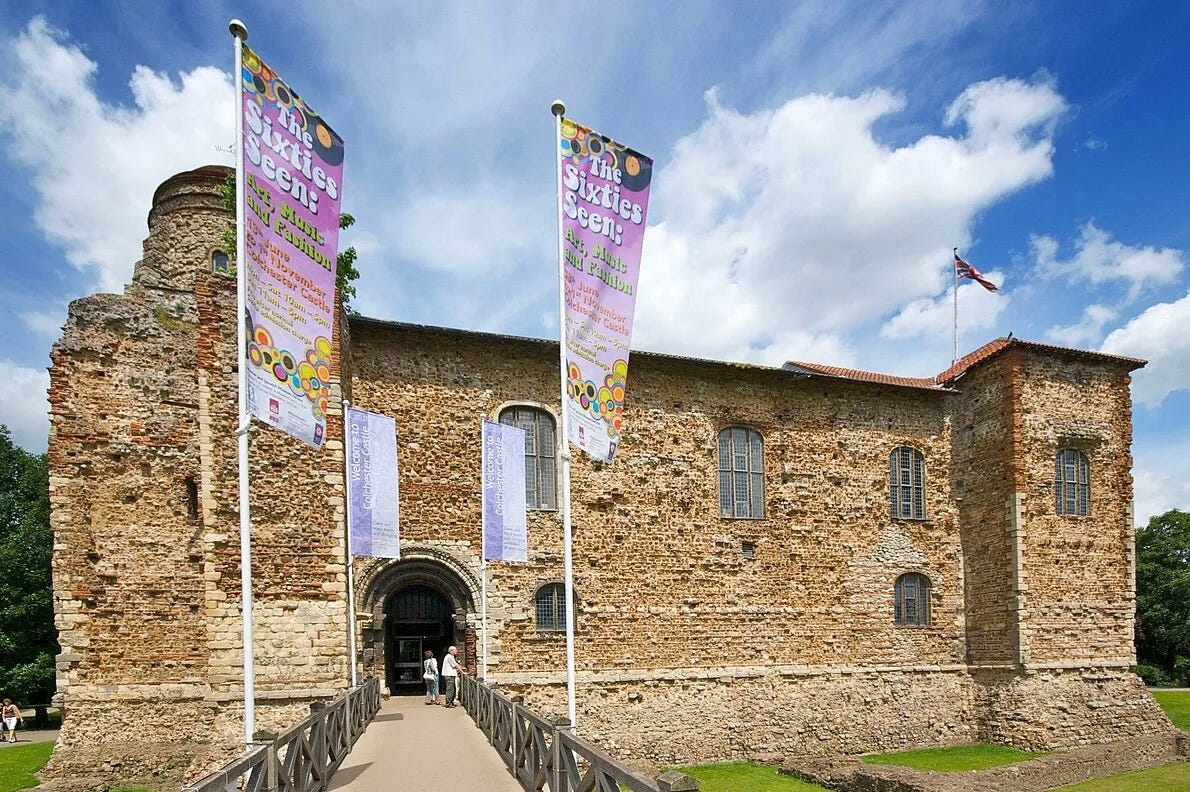
Colchester Castle, the largest Norman keep in Europe and a Grade I‑listed 11th‑century fortress built on the foundations of the Temple of Claudius, is set for essential restoration after a contractor was appointed. A £1,293,625 grant from the Museums Estate and Development Fund (DCMS, administered by Arts Council England), together with support from Colchester City Council and Historic England, will fund repairs focused on the north‑west tower, drainage remediation and vegetation damage to the foundations. Lead contractor PAYE will carry out the work while the castle remains open, with repairs expected to take about six months.
Christmas 1604 ledger shows Shakespeare top of the bill [The National Archives]
The National Archives will display Edward Tilney’s ‘Revells Booke’ (Nov 1604–Oct 1605) from 12 January–5 February, which records one of the earliest performances of Shakespeare’s Othello – listed as The Moor of Venice – at the Banqueting House, Whitehall on Hallamas (Hallowmas, 1 November) 1604. The ledger also documents the King’s Players’ Christmas 1604 repertoire (Merry Wives of Windsor, Measure for Measure, A Comedy of Errors, Love’s Labour’s Lost and Henry V) and shows Tilney received £100 to pay actors, set and costume makers, plus a personal salary of £66 9s 10d. As part of the Revels Office accounts to the Exchequer, the book even names Shakespeare as “Shaxberd” among “the Poets who mayd the plaies”, offering rare insight into James I’s theatrical patronage and tastes.
Bodmin Keep ownership change hailed as ‘important milestone’ [BBC]
The Ministry of Defence has agreed to transfer ownership of Bodmin Keep – the 165-year-old army building that houses 300 years of Cornish military records – to the museum trust, a move director Helen Bishop-Stephens called “a really important milestone”. The keep has been closed since August 2024 after a structural survey found major repair needs, and the trust had been unable to fundraise or commission work while it did not own the building. With the transfer approved (the decision was taken up to the deputy chief of general staff), tenders for repairs and modernisation can now start and the museum hopes to reopen in mid-2027.
Kidderminster carpet museum closure leaves artist ‘heartbroken’ [BBC]
The Museum of Carpet in Kidderminster — which operated for 13 years and housed an extensive collection including two 19th-century handlooms named Victoria and Albert – will close permanently on Saturday amid financial pressures, ending what volunteers say was the UK’s only carpet museum. Volunteer and textiles artist Charlotte Blazier, who used the looms and said volunteering helped her grow as an artist, described the closure as “heartbreaking” and warned it will erase local history many residents no longer understand. She emphasised Kidderminster’s carpet-making roots go back to the Domesday Book and relied on local resources and family piecework – spinning wool, canals, sheep and the River Severn – so the loss means the craftsmanship and historic buildings from the industry’s heyday are disappearing.
British Museum sends artefacts abroad to help countries ‘decolonise’ [The Times]
The British Museum has loaned 80 major artefacts from ancient civilisations, including Egypt, Greece and Mesopotamia, to a Mumbai museum in its largest-ever transfer of objects to India. Its director says three-year international loans are an innovative form of cultural diplomacy aimed at easing disputes over colonial-era acquisitions, which the museum is legally barred from permanently returning. Indian museum leaders say the exhibition helps correct colonial misinterpretations of history, amid ongoing global pressure for the restitution of contested treasures such as the Parthenon Marbles (see above) and the Koh-I-Noor diamond.
Beamish hoping to open archive donations to public in 2026 [BBC]
Beamish Museum in County Durham holds more than 2.5 million items—mostly donated by local people—that document life in north‑east England from the 1820s to the 1950s, but only a relatively small proportion is currently on display. Parts of the museum’s archives, which were accessible before the pandemic, are being readied to reopen to the public in late 2026. Collections director Helen Barker says the archive is a unique, publicly curated snapshot of working‑class life and that reopening it is essential to make the collections accessible and reflect the region’s identity.
Union Jack flown at the Battle of Trafalgar is saved from being sold abroad [Daily Mail]
The government has placed an export ban on a Union Jack believed to have flown from HMS Royal Sovereign at the 1805 Battle of Trafalgar; the hand-stitched wool flag is one of only three survivors from the battle and is valued at about £450,000. The Reviewing Committee on the Export of Works of Art and Objects of Cultural Interest and Culture Minister Baroness Twycross described the battle-scarred flag – linked to Vice-Admiral Cuthbert Collingwood’s ship that led Nelson’s column – as a nationally significant artefact that should remain available to the public in Britain. A decision on whether to grant an export licence has been deferred until mid‑March to give time for a domestic buyer to be found.
The Last Letter of Mary, Queen of Scots [Perth Museum]
The last letter written by Mary, Queen of Scots – penned in the early hours of 8 February 1587 before her execution – will leave the National Library of Scotland’s secure storage for the first time in a generation to go on display at Perth Museum from 23 January to 26 April 2026, marking its longest exhibition in over 20 years and the first modern showing north of Edinburgh. Admission is free (donations welcome, suggested £5) and supporters who pay £4 a month receive free entry to paid exhibitions. A linked pop‑up at Perth’s AK Bell Library will feature related National Library treasures, including Robert Burns’s ‘Lament of Mary, Queen of Scots’ and early manuscripts by Liz Lochhead, and the museum will run a programme of talks and events highlighting Mary’s connections to Perth and Kinross (Huntingtower, Edzell and her imprisonment at Lochleven).
New history trail celebrates Hessle’s ‘fascinating’ past [BBC]
Richard Royal, vice-chairman of Hessle Local History Society, has produced an A3 history-trail handout – an illustrated map highlighting 45 key historic sites around Hessle – to promote the town’s “fascinating” past. The centrefold pull-out will be delivered to residents early next year and free copies will also be available from locations such as Hessle Town Hall and All Saints’ Church. Created by Flexibubble Art with funding from the Do It For East Yorkshire grant, the booklet traces local heritage from a 6th-century settlement and Domesday entry to landmarks like Hesslewood House and the town’s old stocks.
More UK history news out soon!