
Welcome to UK History News. In each monthly issue, free subscribers will receive the latest British history-related headlines, along with notable upcoming anniversaries. And below the paywall, paid subscribers will see many more news items, all of them briefly summarised here in one place.
Top headlines
‘Vanishingly rare’ copy of US Declaration of Independence found by volunteer in UK archives [Heritage | The Guardian]: Archivists at the UK’s National Archives in Kew have discovered a ‘vanishingly rare’ Exeter printing of the US Declaration of Independence – one of only 11 surviving copies and the only one known outside the United States – found among papers taken from the American privateer Dalton after its capture off Spain in December 1776, providing exceptional provenance that illustrates how news of the declaration spread across the Atlantic.
An archival discovery became a treasure map leading a diver to a 17th-century shipwreck carrying coins and gold jewellery [British History | smithsonianmag.com]: Scuba diver and author Todd Stevens discovered and recovered artefacts from the 1680 wreck of the East India Company ship Phoenix off the Isles of Scilly, identifying it by its cannon-piece ballast and donating coins, jewelry, navigational instruments and other personal and cargo items to the Isles of Scilly Museum for public display.
‘Like a miracle’: hidden gold saves Lancashire church from closure [Heritage | The Guardian]: An anonymous gift of nine 1999 gold Britannia coins worth nearly £30,000, found in a plastic bag beneath the altar of 14th‑century St Wilfrid’s Church in Melling on Good Friday with a note signed ‘James, servant of the living God,’ has effectively saved the tiny five‑member congregation from imminent closure by providing seed funds and spurring wider community support toward the £750,000 of urgent repairs.
New footage shows first look at Ernest Shackleton’s final ship Quest [BBC News]: Scientists from the Royal Canadian Geographical Society and Woods Hole Oceanographic Institution have captured the first video footage of Quest – the ship on which Ernest Shackleton died in 1922 – while surveying its wreck in the Labrador Sea off Newfoundland, with the footage produced and edited by Meiying Wu.
No evidence for ‘witches’ marks’ claims at old English buildings, historian says [Heritage | The Guardian]: A leading architectural historian, Jennifer Alexander, argues in a new study that so‑called ‘witches’ marks’ like daisy wheels/hexafoils on medieval buildings are actually stonemasons’ working marks and training exercises – not mystical protection symbols – challenging previous interpretations by English Heritage and Historic England and prompting further research.
Elizabeth I’s spymaster played up her ‘vicious’ temper [Times History]: Research suggests Sir Francis Walsingham made the Tudor queen’s letters more emotional as part of a campaign to influence her cousin Mary, Queen of Scots.
Tudor ring linked to Elizabeth I goes on display [BBC News]: A 1570s gold signet ring engraved with a phoenix – a symbol linked to Anne Boleyn and adopted by Elizabeth I – was found by a Bedfordshire metal detectorist near the former Ampthill Castle, acquired under the Treasure Act, and is now on display at Hampton Court Palace alongside a ring connected to Anne Boleyn’s family.
Bayeux Tapestry arrives in UK for first time in 900 years under police guard [BBC News]: The nearly 1,000‑year‑old Bayeux Tapestry has arrived under tight security at the British Museum from France for a nine‑month loan – the first time it has returned to England in centuries – and will go on display in September after meticulous conservation checks amid French debate over the risks of moving the fragile 11th‑century embroidery depicting the Norman Conquest.
Condoms and love letters all in a castle’s secrets [BBC News]: A team of archivists has catalogued the Greville family papers from Warwick Castle – 800 years of material now searchable online – revealing overlooked stories of women and servants and surprising finds including Beau Brummell love letters, 19th-century animal-gut condoms, drunken toasts at the birth of the future Edward VIII and a servant nibbling a girl’s Easter egg.
New LS Lowry exhibition aims to demolish ‘naive and uncultured’ myth [Exhibitions | The Guardian]: A new MK Gallery exhibition, LS Lowry: The Theatre of Life, will display 140 paintings – including the rarely seen 1932 A Football Match – and aims to ‘bust myths’ about the Mancunian artist by showing he was cultured and depicted leisure and social life as well as industrial scenes, timed to the 50th anniversary of his death.
Is there another king buried under a car park? [BBC News]: Researcher Graham Phillips claims, after a 13-year hunt, to have found King Alfred the Great’s remains under a Winchester car park just yards from the traditional grave marker and is calling for a ground‑penetrating radar survey, but the University of Winchester has not endorsed the unreviewed claim amid a long history of confusing, misidentified and inconclusive finds.
Church gets £1m to restore medieval wall paintings [BBC News]: After a six-year campaign, St Mary de Crypt in Gloucester has won £1m from the National Lottery Heritage Fund to examine and conserve its ‘nationally significant’ wall paintings – including a Tudor Adoration of the Magi that overlays an older medieval (possibly Saxon) mural – with plans for replica and 3D tactile displays, research into techniques, and community engagement.
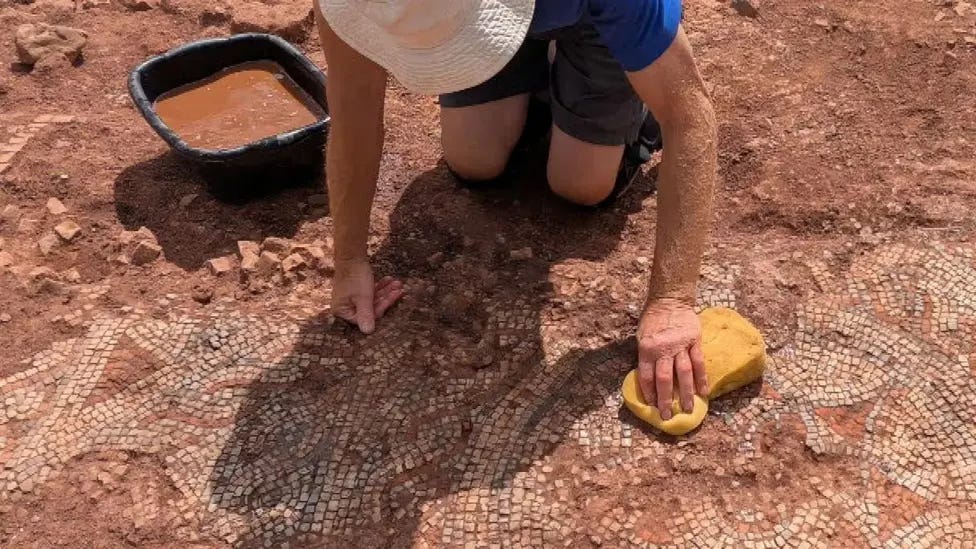
‘Dream’ Roman mosaic find dug up from farmland [BBC News]: Archaeologists, university students and volunteers on the five‑year ‘Saving Halberton’s Ancient Roman Environment’ project have excavated and removed a rare flower‑motif mosaic – part of a large Roman villa first found 16 years ago by metal‑detectorist John Hill in a ploughed field near Sampford Peverell, Devon – which will be conserved for display at Tiverton Museum while researchers investigate connections to nearby Roman military and urban centres.
Ancient Thames site may be Britain’s first hospital [BBC News]: Archaeologists excavating an 8th-century monastery cemetery at Cookham, Berkshire, have found remains showing tuberculosis, cancer and severe injuries – evidence the site may have functioned as an early Christian care facility or Britain’s first hospital centuries before the Norman Conquest – while researchers use ancient DNA and chemical analyses and train students on site.
London is getting a new museum showing off Roman and medieval fortifications [ianVisits]: London will open a free public museum at 20 Giltspur Street (near St Paul’s and Farringdon) expected in December, making accessible a long-hidden Scheduled Monument – a section of the Roman Wall and a medieval bastion discovered beneath a former Post Office – with a two‑floor display of artefacts (including a rare Roman Minerva statue), interpretation panels and limited-capacity visits for which pre-booking is encouraged.
The best of UK history publishing
Heritage Hunter publishes a wide variety of books relating to British family/social/local history, heritage and historical travel.
Also available: professional history publishing services for your book.
Notable anniversaries coming up
5 August
125 years ago...1901: Death of Victoria, Princess Royal of the United Kingdom and German Empress (born 1840)
6 August
100 years ago...1926: Gertrude Ederle becomes the first woman to swim across the English Channel.
26 August
350 years ago...1676: Birth of Robert Walpole, English politician, Prime Minister of the United Kingdom (died 1745)
27 August
70 years ago...1956: The nuclear power station at Calder Hall in the United Kingdom was connected to the national power grid becoming the world’s first commercial nuclear power station to generate electricity on an industrial scale.
Articles to read
Pigeons or pirates? Mystery behind beach’s secluded cave in the cliffs [BBC News]: Culver Hole, a puzzling 13th–14th-century stone façade with mismatched windows set into the cliffs at Port Eynon Point on the Gower peninsula, has long inspired local folklore of pigeoncote, castle and smuggler John Lucas but remains an enigma because its inaccessible location, fine masonry and lack of conclusive evidence leave its original purpose unknown.
The forgotten powerhouse in the forest [BBC News]: Fernhurst Furnace, a 17th–18th century blast furnace hidden in the Sussex Weald that once produced cast iron for household goods, tools and cannons, was only rediscovered in 1987 on land owned by Robin and Carla Barnes and is now a conserved Scheduled Ancient Monument where researchers say water power and vast charcoal production once drove a noisy ironworking site but today only birdsong and the trickle of water remain.
The little village with a big Viking past [BBC News]: Stow Minster, a church dating to 975 about eight miles south of Gainsborough – briefly the Viking-era capital when Sweyn Forkbeard was proclaimed king in 1013 – contains a more-than-1,000-year-old graffiti carving of a Viking longship, one of the earliest known in England, providing rare physical evidence of Lincolnshire’s Viking presence, trading links and later Christianisation.
Country diary: The field names here read like a history book | Eben Muse [Heritage | The Guardian]: On Ynys Enlli (Bardsey Island), a stroll along its single road uncovers a living palimpsest – field names, ruined farmsteads and small-scale features that both puncture the legend of 20,000 saints and trace a shift from once-diverse medieval agriculture and pilgrimage to a sheep-grazed, post-harvest landscape whose placenames preserve community memory and hint at possible revival.
From wig curlers to cream pots, new discoveries shine a light on Georgian social whirl [Daily Express :: History Feed]: The £20m restoration of Bath Assembly Rooms has unearthed hundreds of Georgian and Victorian artefacts – from wig curlers, a porcelain beauty pot and embossed wine bottles to clay tobacco pipes, animal bones and decorative platter fragments – providing fresh insight into the fashions, dining and social life of 18th–19th century Bath (frequented by Jane Austen) and many of which will be displayed when the Grade I-listed venue reopens next year.
⭐️ Paying subscribers can read 36 further news stories below!
Plus, if you’re into archaeology, folklore and landscape stories, read my other, free newsletter…

