
Welcome to UK History News. In each fortnightly issue, free subscribers will receive the latest British history-related headlines, along with notable upcoming anniversaries. And below the paywall, paid subscribers will see many more news items, all of them briefly summarised here in one place.
Top headlines
Lawrence of Arabia centre planned at new museum [BBC]: Wareham Town Council has bought a vacant former bank next to its museum – after 55% of residents voted in 2025 to pay an extra £50 in council tax to help fund the purchase – to expand the town museum into the recognised national centre for T.E. Lawrence, housing the T.E. Lawrence Society collection and a new tourist information centre.
First look inside Wales’ new national football museum ahead of 2026 opening [Wales 247]: The Football Museum of Wales, a nearly completed, community‑developed attraction just half a mile from Wrexham AFC that has received almost £6m in Welsh Government grants (over £6.78m total investment), gave Culture Minister Jack Sargeant a behind‑the‑scenes preview this week and will open in summer 2026 with interactive galleries, films and exhibits celebrating Wales’s diverse football heritage.
Actor Cooper’s detecting lesson leads to gold find [BBC News]: When actor Charlie Cooper took friend and assistant director Matt Bell metal detecting near Saffron Walden, Essex on 5 March, Bell unexpectedly unearthed an Iron Age gold stater – likely dating to AD 10–43 in the reign of Cunobelinus – on his first try, a find the pair reported to the Portable Antiquities database and hope to donate to a museum.
Roman well unearthed during shop renovations [BBC News]: While restoring a former shop in Caistor, Lincolnshire, a community trust uncovered a capped Roman well along with Georgian-style wall panels and 17th-century timber work that they hope to restore as part of a £4.4m ‘heritage hub’ conversion but currently lack an extra £25,000 to proceed.
Lord Ashcroft’s VCs and GCs to have a new home at the National Army Museum [National Army Museum]: Lord Ashcroft’s world‑largest collection – comprising nearly 250 Victoria Crosses and a smaller number of George Crosses – will move on long‑term loan to the National Army Museum in Chelsea, London, with full public display within two years and some medals appearing from July alongside exhibitions, educational programmes and digital content.
‘You can’t wipe out Whitby’s whaling past with replica arch’ [BBC]: Whitby’s iconic Whalebone Arch – a symbol of the town’s 18th‑century whaling heritage – is deteriorating and has sparked debate over ethical and logistical challenges of using real bones, leading the town council to endorse a circa £60,000 bronze replica (with final approval by North Yorkshire Council pending).
English Heritage make major Cold War discovery at UK seaside castle [Daily Express]: English Heritage has unearthed a long-buried Cold War Royal Observer Corps lookout post at Scarborough Castle – one of more than 1,500 near-identical 1963–64 brick-and-concrete posts sealed in 1968 to detect nuclear explosions – revealing intact brickwork and highlighting the largely volunteer corps’ role in Britain’s civil defence.
Rare items of Charles Dickens’ clothing to go on display in London [The Guardian]: The Charles Dickens Museum in London opens an exhibition on 11 March showing rare surviving clothing and personal effects – most notably the linen shirt collar Dickens wore when he suffered his fatal stroke in 1870 – alongside his black silk stockings from his only surviving suit, grooming items and a colourised portrait that together illuminate his flamboyant ‘dandy’ style.
Lost home linked to American War of Independence [BBC News]: Woods off the A249 hide the footprint of Rose Hill (later the Grove), a Kent estate demolished in the 1970s and uncovered in 2015 by the Sittingbourne Historical Research Group with local pupils, which was once home to Frances and British Army engineer John Montresor – linked to the American War of Independence and the spy Nathan Hale, with Frances’s portrait now in the US State Department – after the family lost Belmont House following a government audit, and the house likely featured distinctive yellow mathematical tiles.
Events to mark 375 years since Battle of Worcester [BBC News]: To mark the 375th anniversary of the Battle of Worcester – the final clash of the English Civil War in 1651 that led to Charles II’s escape and the Cromwellian republic – Worcester is staging year‑long talks, museum exhibitions, family activities and Civil War re‑enactments at sites including the Commandery, Tudor House, The Hive and the Cathedral.
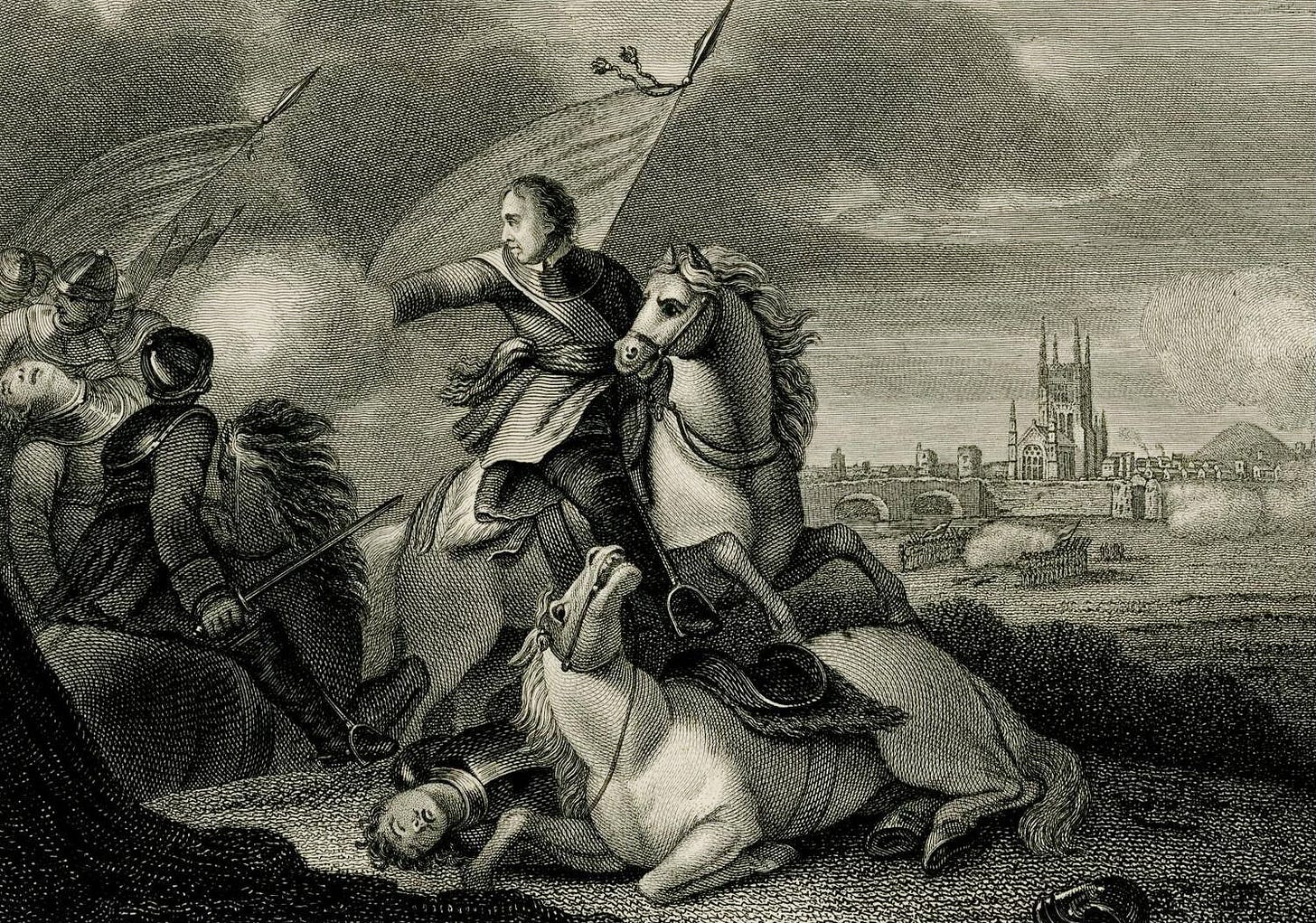
Oliver Cromwell at the Battle of Worcester. Vast scale of overseas human remains held in UK museums decried by MPs and experts [The Guardian]: A Guardian investigation found UK museums hold over 263,000 items of human remains – including thousands taken from former colonies – many stored or displayed disrespectfully and poorly catalogued, prompting MPs, archaeologists and campaigners to demand a national register and timely repatriation.
Winston Churchill historians unearth World War 2 PM’s forgotten ‘obsession’ [Daily Express]: On the 80th anniversary of Winston Churchill’s ‘Iron Curtain’ speech, historians Richard Toye and Warren Dockter reveal an overlooked 1923 newspaper piece in which Churchill framed anti‑Bolshevism as one of his ‘obsessions,’ offering fresh context for his 1946 warning about Soviet expansion and his call for closer Anglo‑American ties.
Kylie Minogue ancestor’s execution pamphlet sold [BBC News]: A rare 1816 pamphlet recounting the 7 September execution of Dinah Riddiford, aged 69 – said to be the oldest woman hanged in England and a five-times-great-grandmother of Kylie Minogue – and co-defendant John Williams sold at a Gloucester auction for £650, above estimate, despite originally being cheaply printed as a sensational warning to would-be criminals.

Notable anniversaries coming up
17 March
250 years ago... 1776: American Revolution: The British Army evacuates Boston, ending the Siege of Boston, after George Washington and Henry Knox place artillery in positions overlooking the city.
350 years ago... 1676: birth of Thomas Boston, Scottish philosopher and theologian (died 1732)
21 March
225 years ago... 1801: The Battle of Alexandria is fought between British and French forces near the ruins of Nicopolis near Alexandria in Egypt.
24 March
80 years ago... 1946: A British Cabinet Mission arrives in India to discuss and plan for the transfer of power from the British Raj to Indian leadership.
250 years ago... 1776: death of John Harrison, English carpenter and clockmaker, who invented the Marine chronometer (born 1693)
25 March
450 years ago... 1576: Jerome Savage takes out a sub-lease to start the Newington Butts Theatre outside London.
26 March
300 years ago... 1726: death of John Vanbrugh, English playwright and architect, who designed Blenheim Palace and Castle Howard (born 1664).
29 March
275 years ago... 1751: death of Thomas Coram, English captain and philanthropist, who founded the Foundling Hospital (born 1668)).
Articles to read
The village on the frontline in the Battle of Medway [BBC News]: Aylesford, a village on the River Medway near Maidstone, was the crucial ford where about 40,000 Roman troops in AD 43 – part of Emperor Claudius’s invasion – crossed (with a specialist unit flanking near Snodland), fought a two-day battle against local tribes, and secured a Roman victory, now commemorated by a stone in nearby Leybourne.
We mixed modern and medieval skills cleaning Canterbury Cathedral’s gate [Times History]: A team of stonemasons spent ten years cleaning centuries of grime from Christ Church Gate, using lasers to reveal angels, flora and mythical beasts.
Tudor courtiers exchanged portrait miniatures as love tokens. centuries later, new research is unlocking the secrets of these intimate artworks [smithsonianmag.com]: Over the past few years, art historians have identified several previously unknown paintings by Elizabeth I’s favorite artist, Nicholas Hilliard
The small village that became a Mecca for cyclists [BBC News]: Long before Box Hill, the Surrey village of Ripley – opened up by the railway and reached via the Ripley Road from London – became the late-19th-century epicentre of mass recreational cycling, drawing thousands to social hubs like the Anchor Inn before tea-shop culture, road modernization and cars ended its heyday and left its pioneering role largely forgotten.
Who was Ann Lee who inspired a Hollywood film? [BBC News]: Born in poverty in Manchester in 1736, illiterate Ann Lee became the charismatic ‘Mother’ and self-proclaimed female redeemer of the Shakers – championing celibacy, communal living and gender equality – who led her followers to the United States in 1774, founded a movement that grew to thousands and left a lasting legacy (including Shaker furniture), and whose extraordinary life is now dramatized in the film The Testament of Ann Lee starring Amanda Seyfried.
How 150 years of the telephone changed our lives [Times History]: From scientific breakthrough to iPhone dominance, the remarkable journey of the invention that transformed work and play – and even the way we speak.
⭐️ Paying subscribers can read 40 further news stories below!
Plus, if you’re into archaeology, folklore and landscape stories, read my other, free newsletter…

