
Welcome to UK History News. In each fortnightly issue, free subscribers will receive the latest British history-related headlines, along with notable upcoming anniversaries. And below the paywall, paid subscribers will see many more news items, all of them briefly summarised here in one place.
Top headlines
Wolverine’s remains from 80,000 years ago found in archaeological UK cavern breakthrough [Daily Express]: Members of the Craven Potholing Club digging by hand in Stump Cross Caverns, Yorkshire Dales, have uncovered an 80–90,000‑year‑old prehistoric wolverine jaw – an Ice Age discovery that will be preserved, studied by palaeontologists, and showcased to future visitors.
Brontë village braces for Wuthering Heights overtourism tidal wave as TikTokers make for the Moors - with one local historian saying tourists think ‘Haworth is like Disneyland’ [Daily Mail]: Haworth, the tiny West Yorkshire village where the Brontës lived, is bracing for a likely surge – potentially to hundreds of thousands – of mainly social‑media‑savvy visitors following the release of Emerald Fennell’s Wuthering Heights starring Margot Robbie and Jacob Elordi, a boon for local businesses already seeing bigger crowds but one that has residents worried about parking, infrastructure and overtourism.
Town with 3,000 years of culture aiming for UK title [BBC News]: Bolstered by its rich Iron Age heritage – including a 2017 discovery of an Arras‑culture chariot and charioteer – and a lively local arts, sports and festival scene, the market town of Pocklington in East Yorkshire is bidding to become the UK’s first Town of Culture in 2028, competing for a £3m prize to boost community pride and cultural projects.
‘Oldest northerner’ cave remains are of young girl [BBC News]: Archaeologists at Heaning Wood Bone Cave near Great Urswick, Cumbria have confirmed that 11,000-year-old bones once thought to be male are actually those of a female child aged about 2½–3½ – dubbed ‘Ossick Lass’ – representing the oldest known Mesolithic burial in northern Britain and one of at least nine deliberate interments at the site, according to DNA and radiocarbon analysis published in the Proceedings of the Prehistoric Society.
Love letters reveal secrets of century-old affair [BBC News]: English Heritage has acquired a shoebox of 108 letters from the 1920s revealing a passionate, sometimes scandalous, love affair between Witley Court resident Dora Smith and Noel ‘Fred’ Pearson – an affair that began during Dora’s first marriage, ended in their 1929 marriage (Pearson later died in 1941) – and is now being studied for historical significance while experts seek descendants to fill in the story.
We’ll Meet Again – in the Museum: Dame Vera Lynn’s letters to be displayed at IWM [ianVisits]: The Imperial War Museums will display a selection of Dame Vera Lynn’s personal archive this spring 2026 – donated by her daughter Virginia Lewis-Jones and including her BBC contract for Sincerely Yours, about 600 wartime letters, her 1944 ENSA diary and personal items – while the wider collection is conserved and catalogued to preserve the legacy of the ‘Forces’ Sweetheart’ whose broadcasts and songs like ‘We’ll Meet Again’ sustained troops and families during WWII.
Crime and LGBTQ+ in dock at Bow Street [Westminster Extra]: The Bow Street Museum of Crime and Justice has restored and reopened the original Court 2 dock where Oscar Wilde stood during his 1895 gross indecency trial, backed by over £100,000 from the National Lottery Heritage Fund to create an exhibition – ‘Echoes from the Dock’ – examining LGBTQ+ experiences with the criminal justice system and making the historic dock accessible to the public for the first time since the court closed 20 years ago.
Birthplace of hymn Cwm Rhondda saved by fundraising drive [The Guardian]: Supporters raised £73,000 to buy Capel Rhondda in Hopkinstown – the Grade II‑listed Welsh valleys chapel where the hymn Cwm Rhondda (‘Bread of Heaven’) was first sung – transferring it into community ownership, backed by a £10,000 Welsh government grant for surveys and repairs, with plans to preserve it as a Welsh‑language and choir-friendly community space.
Iron Age hoard to go on public display this summer [BBC News]: The Melsonby Hoard – a collection of more than 800 Iron Age artifacts including chariot wheels, cauldrons and spears uncovered in North Yorkshire – has been acquired by the Yorkshire Museum after a public fundraising campaign and will go on display in York from May, offering a major new resource for studying late Iron Age Britain.
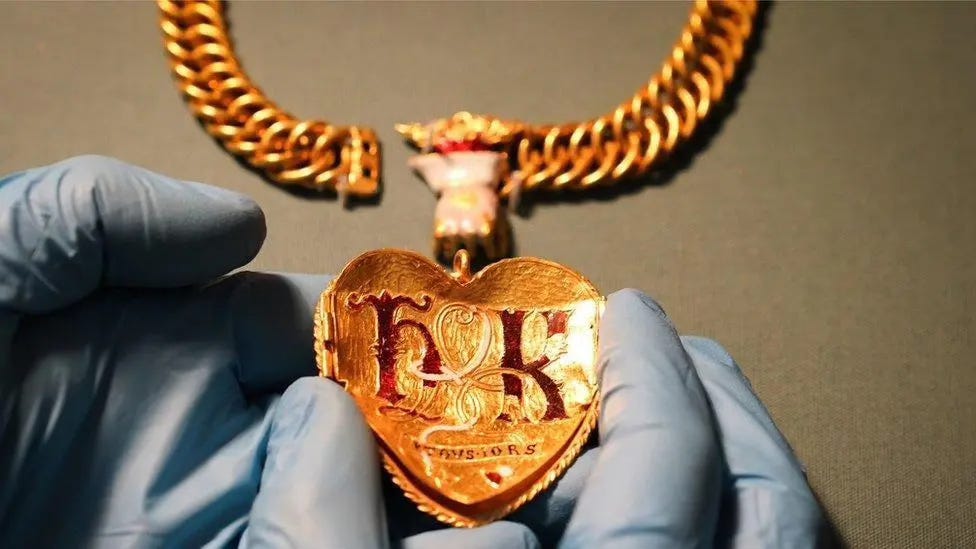
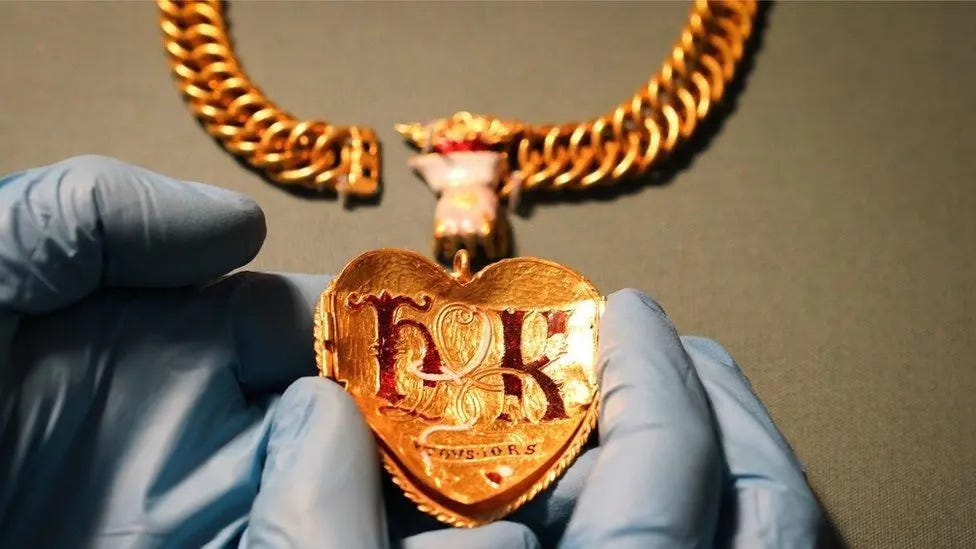
British Museum to keep pendant linked to Henry VIII [BBC News]: The British Museum has raised £3.5m – including £360,000 from over 45,000 public donors and a £1.75m grant from the National Heritage Memorial Fund – to permanently acquire the ‘Tudor Heart,’ a gold pendant linked to Henry VIII’s marriage to Katherine of Aragon (likely commemorating Princess Mary’s 1518 betrothal), which it plans to display and tour.
Picture: PA News Shipwreck timbers from 17th Century appear on beach [BBC News]: Storm Chandra uncovered roughly 6m of historic timbers at National Trust-owned Studland Bay in Dorset, which maritime archaeologists think could be part of the 1631 Swash Channel wreck – likely the Dutch armed merchantman Fame of Hoorn – awaiting dendrochronology to confirm origin and potential excavation under Historic England protection, with visitors urged not to touch the fragile remains.
Rumours suggested that Anne Boleyn was a witch with six fingers. Did this Elizabethan artist rework a portrait of the Tudor queen to debunk the gossip? [smithsonianmag.com]: A new analysis of the Hever Rose portrait suggests that the painter deliberately modified an existing template to showcase Anne’s hands – with no extra digits – holding a delicate rose
‘Bullet’ used in Bonnie Prince Charlie shooting attempt found in bed [BBC News]: A 13.5mm lead projectile fragment – likely from a pistol – was found inside the original headboard of a bed at Bannockburn House in Stirling, adding physical evidence to a suspected assassination attempt on Bonnie Prince Charlie in January 1746 and complementing a previously discovered bullet hole in the room, with further ballistics tests planned.
From Dorset to the world: wave of donations helps to secure Cerne giant’s home [The Guardian]: With donations from more than 20 countries, the National Trust has reached its £330,000 public fundraising target (after putting in £2.2m of its own funds) to buy land around the 55m Cerne Abbas chalk giant – securing access, linking habitats to protect wildlife like the endangered Duke of Burgundy butterfly, and enabling further archaeological study and conservation including re-chalking.
Notable anniversaries coming up
1 March
80 years ago... 1946: The Bank of England is nationalised
Articles to read
Infamous grave tells tragic story of unknown boy buried far from home [Daily Express]: The mysterious grave of ‘Sambo’ at tidal Sunderland Point – believed to be an African boy brought to Lancashire via 18th‑century transatlantic trade and memorialized by a late‑18th‑century epitaph – remains a protected, well‑visited shoreline site where people still leave flowers and pause to reflect.
The Victorian aristocrat who became first British Muslim lord [BBC News]: Lord Henry Stanley (1827–1903), a private Victorian aristocrat and former diplomat who converted to Islam around 1859 – reportedly taking the name Abdul Rahman – became the first Muslim member of the House of Lords after inheriting his title in 1869, provoking family scandal but remaining an influential landowner who blended Islamic observance with respect for Christianity.
Britain’s first all-female prison stood in Surrey [BBC News]: Opened in 1869 on the outskirts of Woking as Britain’s first purpose‑built women’s prison with capacity for about 780 and built largely by male convicts for roughly £45,000, the complex was largely closed by 1895 as the female convict population fell, later served as a WWI military hospital, and is now mostly housing – apart from some former officer terraces – with decorative mosaics from its grounds preserved in places such as St Paul’s Cathedral and the V&A.
‘A whole lost culture’: the Irishman reviving the forgotten sport of stone lifting [The Guardian]: David Keohan – Instagram’s ‘Indiana Stones’ – has revived Ireland’s centuries-old practice of lifting designated boulders, locating some 53 historic stones and galvanizing an international social-media following, competitions and heritage campaigns to reconnect people with Irish folklore, community rites and history.
How a missing infant uncovered prolific baby traffickers [BBC News]: In 1907 Herbert Smith and Lottie Roberts, a travelling showbiz couple who advertised to ‘adopt’ infants for a fee then handed them to neglectful ‘baby farms,’ were arrested after the suspected death of a two‑week‑old Grimsby boy – an inquiry that exposed a nationwide baby‑trafficking racket, led to convictions for trafficking at least 15 babies and short prison terms, and ultimately saw the Grimsby infant returned to his family.
The MP said to be the first person to die in a railway accident in Britain [Daily Express]: Parkside station in St Helens – one of the original Liverpool and Manchester Railway stations – is the site where MP William Huskisson was struck and fatally injured by the Rocket on 15 September 1830 during the line’s opening (an inquest called it an accident and a memorial was erected in 1831), an event widely regarded as the first railway fatality despite a recorded 1827 death, and Huskisson’s contested legacy (including his defence of slavery) has fuelled later debate over a statue plinth in Liverpool.
⭐️ Paying subscribers can read 43 further news stories below!
Plus, if you’re into archaeology, folklore and landscape stories, read my other, free newsletter…

