
Welcome to UK History News. In each fortnightly issue, free subscribers will receive the latest British history-related headlines, along with notable upcoming anniversaries. And below the paywall, paid subscribers will see many more news items, all of them briefly summarised here in one place.
Top headlines
£25 car boot Captain Cook medal sells for £5,000 [BBC]: A rare 18th-century bronze ‘Death of Captain Cook’ medal – one of only three known examples – was bought at a West Yorkshire car‑boot sale for £25 and has sold at auction for £5,000 to the Captain Cook Memorial Museum in Whitby to feature in its 300th‑birthday exhibition commemorating Cook’s 1779 death.
Ethelred the Unready coin hoard found by Maldon detectorist [BBC]: Metal detectorists near Maldon have unearthed a hoard of 14 well‑preserved Saxon silver pennies struck for Ethelred II between AD 997–1003, declared treasure and sought by Braintree Museum, alongside a separate 6th‑century gilded silver sword pommel cap from Hatfield Peverel – finds that likely represent a significant sum (about two weeks’ wages) and provide rare evidence of early medieval activity in Essex.
‘World-class’ £54m fashion museum could open in city [BBC News]: Bath and North East Somerset Council is seeking planning approval next week to convert the historic former post office on New Bond Street into a ‘world-class’ £54m fashion museum – housing a 100,000‑piece collection and due to open in 2030 – funded partly by grants and requiring about £20m of council borrowing, with planning officers recommending approval.
Why did this wealthy Scotsman pay a jeweler to wrap his teeth in gold wire hundreds of years ago? [British History | smithsonianmag.com]: Researchers have identified Scotland’s oldest dental bridge – a 20‑karat gold wire found between the lower front teeth of a middle‑aged man (died 1460–1670) excavated at St. Nicholas Kirk in Aberdeen – indicating rare, likely functional and cosmetic medieval dental work performed for an upper‑class individual.
This sailor from the Franklin expedition died in the Arctic in a uniform that didn’t belong to him. Now, DNA has revealed his identity [smithsonianmag.com]: DNA analysis has confirmed that the skeleton found on King William Island in 1859 – discovered with the famously inscrutable ‘Peglar Papers’ and clothing more typical of a steward – is Henry Peglar of HMS Terror, making him the sixth Franklin expedition crew member identified and adding forensic clarity to the fate of the doomed 1845 voyage that ultimately ended in death from exposure, disease, starvation and, as bone evidence and Inuit testimony show, cannibalism.
WW2 spy boat replica honours Cornwall’s links to espionage group [BBC]: Volunteers have built and launched an 8m replica of the SOE SN2 surf boat – famous for clandestine supply landings and a Christmas Day 1943 rescue of Allied airmen off Brittany – which will undergo sea trials and feature in a new National Maritime Museum Cornwall display.
Historic Oxford cinema under threat as Oriel College refuses to extend lease [The Guardian]: The Ultimate Picture Palace, a community-owned Grade II-listed independent cinema in east Oxford that opened in 1911, faces an uncertain future after landlord Oriel College refused to extend its lease past 2037 – preventing grant-funded energy, accessibility and renovation work and leaving the beloved venue financially precarious despite thousands of public supporters and a 22,000-signature campaign.
Largest Thomas Hardy collection free to view [BBC News]: An extensive Thomas Hardy archive – believed to be the largest, comprising more than 100 boxes with over 5,000 letters, notebooks, sketches and draft manuscripts for major novels (including Under the Greenwood Tree, The Mayor of Casterbridge and The Woodlanders) and correspondence with contemporaries such as Robert Louis Stevenson, Millicent Fawcett and Virginia Woolf – has been catalogued, partially digitised and made freely available by appointment at the Dorset History Centre, with the catalogue online after a 2024 project supported by Dorset Archives Trust.
Tales of tunnels underneath village prove to be true [BBC News]: After a 2024 Facebook thread prompted villagers to form the Bloxham Underground Tunnel Society, locals have spent two years uncovering an expanding network of subterranean passageways beneath the north Oxfordshire village – including a large tunnel exposed by a garage excavation that yielded animal bones (including a red deer skull) suggesting pre‑medieval or possibly Roman origins and prompting plans for carbon dating as they investigate whether the tunnels were reused across centuries, for example by Catholic clergy during the Reformation.
Salisbury Cathedral restores stained-glass treasure by Edward Burne-Jones and William Morris [Exhibitions | The Guardian]: After a two-year conservation project led by head glazier Sam Kelly, Salisbury Cathedral’s 6.5m Burne-Jones and Morris ‘Angels’ stained-glass window – carefully cleaned, stabilized with backing glass and fitted with protective glazing to preserve original painted detail – has been hailed a huge success and will be rededicated at evensong on 7 May, the dean saying its restored beauty will ‘lift spirits and rekindle hope.’
‘It’s a special tree’: campaign to save mother of beloved bramley apple for nation [The Guardian]: Campaigners have launched a crowdfund to raise £250,000 to buy a Southwell, Nottinghamshire cottage – home to the 220-year-old ‘mother’ Bramley apple tree from which all Bramley apples descend – and turn it into a publicly accessible heritage centre to protect the historically and commercially important tree.
Mystery sitter in Holbein portrait could be Anne Boleyn, AI analysis finds [The Guardian]: Researchers using AI to reanalyze Hans Holbein’s Tudor sketches say 18th-century mislabelling may mean the ‘Unidentified Woman’ is actually Anne Boleyn and the ‘Windsor sketch’ her mother Elizabeth Howard, prompting calls to reassess longstanding attributions in the royal collection.
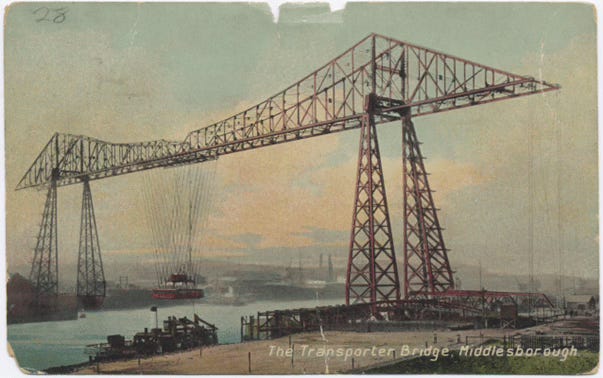
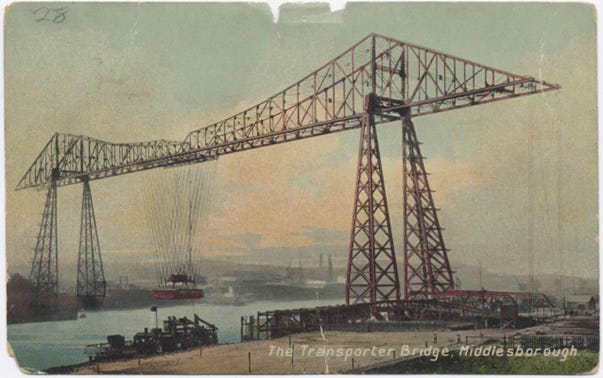
Victorian Society publishes list of most endangered buildings in England and Wales [The Guardian]: The Victorian Society has named ten endangered Victorian and Edwardian sites across England and Wales – including the 1911 Tees Transporter Bridge (facing an estimated £60m repair bill – see next item), Hackney’s Clapton disinfecting station, Barrow’s former Strand Railway Station/working men’s club, a neglected north Wales mausoleum and an Essex house with rare Elizabeth Arkwright interiors – warning that these largely listed but decaying buildings face continued neglect or arson without urgent national coordination, funding and reuse plans.
World’s longest working transport bridge in UK town ‘hangs in the balance’ - 115 years old [Daily Express]: The future of the iconic Tees Transporter Bridge – closed since 2019 over serious structural concerns – is uncertain as Stockton and Middlesbrough councils confront an estimated £60m+ repair bill, with heritage groups calling for national support while surveys and preliminary restoration designs proceed pending funding and a decision on whether to preserve the original steel or rebuild.
Lost copy of seventh-century poem in Old English discovered at Rome library [The Guardian]: Trinity College Dublin scholars have discovered a previously unknown c. AD 800–830 manuscript at Rome’s National Central Library containing the Old English text of Caedmon’s Hymn – the earliest surviving English poem attributed to a seventh‑century Northumbrian cattle herder – notable as the third‑oldest copy, for presenting the Old English in the main text (showing early word division), and for being revealed through recent library digitisation.
ENCOUNTERS WITH LANDSCAPES
Friday 22 May • Quaker Meeting House, Central Oxford • 7–9pm
An evening of short films and discussions featuring…
Paul Whitewick, archaeology/landscape YouTuber (248,000 followers)
James Attlee, award-winning psychogeographical writer
Louise Ryland-Epton, early modern historian and John Aubrey expert
C.M. Taylor, award-winning filmmaker and writer
Notable anniversaries coming up
12 May
100 years ago... 1926: The United Kingdom general strike ends.
14 May
75 years ago... 1951: Trains run on the Talyllyn Railway in Wales for the first time since preservation, making it the first railway in the world to be operated by volunteers.
20 May
300 years ago... 1726: birth of Francis Cotes, English painter and academic (died 1770)
21 May
60 years ago... 1966: The Ulster Volunteer Force declares war on the Irish Republican Army in Northern Ireland.
22 May
200 years ago... 1826: HMS Beagle departs on its first voyage.
24 May
450 years ago... 1576: birth of Elizabeth Carey, Lady Berkeley, English courtier (died 1635)
Articles to read
I took one of the most famous photos of the Aberfan disaster - it still haunts me [BBC News]: Mel Parry, an 18‑year‑old apprentice whose photograph of PC Victor Jones carrying eight‑year‑old Susan Maybank after the 1966 Aberfan spoil‑tip collapse that killed 116 children and 28 adults became an iconic, award‑winning image he later regretted – abandoning photography, donating his British News Photographer of the Year trophy to the national museum – and watched the photo recur in remembrances even after Susan, who survived the disaster, died in 2025.
People are only just realising ‘vital’ reason why some street railings have kinks [Daily Express]: Many of London’s distinctive bent street railings are actually WWII Air Raid Precaution emergency stretchers – simple, single-material designs used to carry wounded civilians during the Blitz and later repurposed when railings were rebuilt – a history recently highlighted in a viral TikTok by historian Alice Loxton.
In the ancient world, this pigment was worth more than gold. Archaeologists discovered it buried with babies in Roman coffins [smithsonianmag.com]: Archaeologists in York found remnants of rare Tyrian purple dye – made from murex sea snails and once reserved for emperors and clergy – preserved with gold-thread flecks in cloth inside gypsum-cast Roman-era infant coffins, a first-for-the-city discovery that shows wealthy families in Roman Britain afforded extraordinary burial treatments for children about 1,700 years ago.
⭐️ Paying subscribers can read 28 further news stories below!
Plus, if you’re into archaeology, folklore and landscape stories, read my other, free newsletter…

